
|

 AmLight Activates Terabit Bandwidth Capacity on the Monet Submarine Cable
February 2026
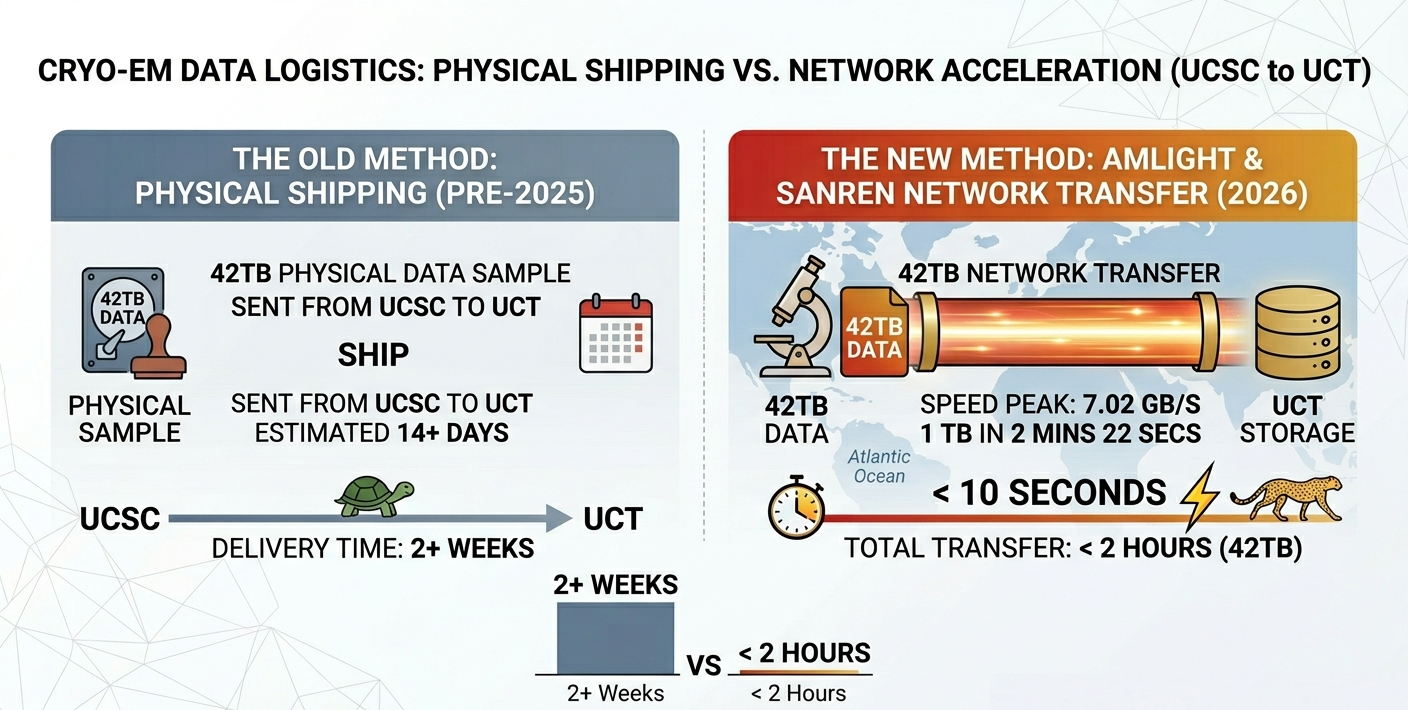
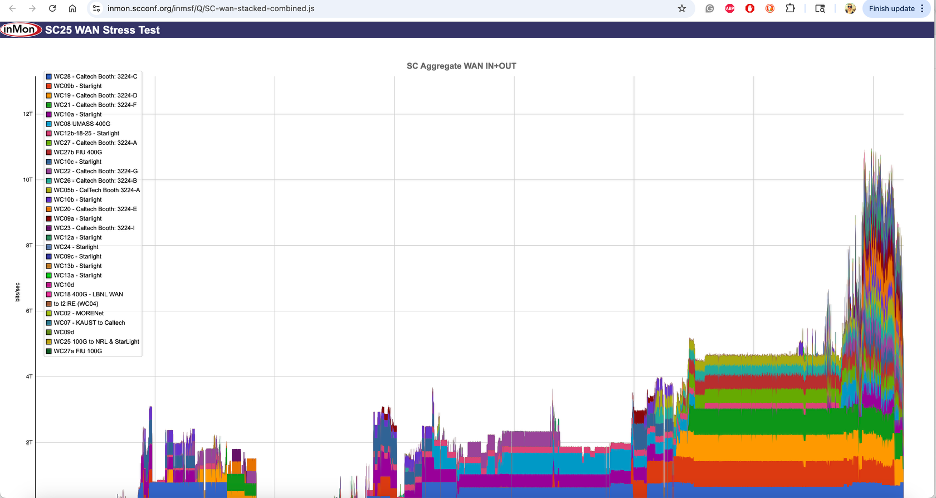
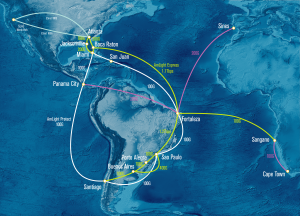
In a major leap for global scientific collaboration, the AmLight project at Florida International University (FIU) has successfully activated terabit-scale bandwidth, reaching 1 Tbps between Florida and Brazil and 1.2 Tbps between Fortaleza and São Paulo. Achieved in partnership with Angola Cables, RNP, and Ciena, this milestone utilizes the latest WaveLogic 6E technology to support the massive data demands of projects like the Vera C. Rubin Observatory, CERN’s Large Hadron Collider, and global climate modeling. By enabling the transfer of petabyte-scale datasets in just hours, this high-capacity infrastructure, funded by the National Science Foundation, solidifies AmLight’s role as a critical backbone for data-intensive research across the Western Hemisphere and beyond … Read More
|
NSF-DOE Vera C. Rubin Observatory launches real-time discovery machine for monitoring the night sky
February 24, 2026
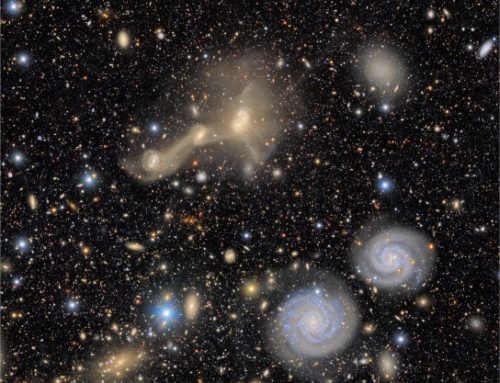
The NSF–DOE Vera C. Rubin Observatory reached a historic milestone on February 24, 2026, by issuing its first 800,000 scientific alerts, signaling the start of a new era in real-time astronomy. Utilizing the world’s largest digital camera, the observatory scans the Southern Hemisphere sky to detect transient events—such as supernovae, moving asteroids, and flickering stars—generating public alerts within just two minutes of image capture. This “discovery machine” is expected to scale up to seven million alerts per night, providing a continuous data stream that allows scientists globally to coordinate immediate follow-up observations. As a precursor to the 10-year Legacy Survey of Space and Time (LSST) launching later this year, this system will fundamentally transform our understanding of dark matter, dark energy, and the dynamic nature of the changing cosmos … Read More
|
 SENSE 26.01 Unlocks Intercontinental Network Visibility via AtlanticWave-SDX
February 5, 2026
The ESnet SENSE project team released the SENSE Orchestrator 26.01 (Final) on January 21, 2026. This biannual major release delivers important stability improvements, dependency modernization, usability enhancements, and refined visualization behavior. A cornerstone of this release is the formal integration with the AtlanticWave-SDX project, through a component referred to as the “SDX driver”. The AtlanticWave-SDX API was first integrated with SENSE in release 2025.1.1, and later improved in release 2026.1. The SENSE SDX driver is a key component in the SENSE-O (Orchestrator) stack. It is used to communicate with the AtlanticWave-SDX controller to gather information about topology and available resources, to provision L2 circuits, and to enable service monitoring. By integrating SENSE and SDX, the R&E community, especially users of SENSE, will benefit from visibility to a variety of resources spread across distributed intercontinental Open Exchange Points (OXPs) in the U.S., Chile, Brazil, and South Africa … Read More
|
 TANGO/CoNGA@SC25: Dancing Toward More Sustainable Cyberinfrastructure
January 16, 2026
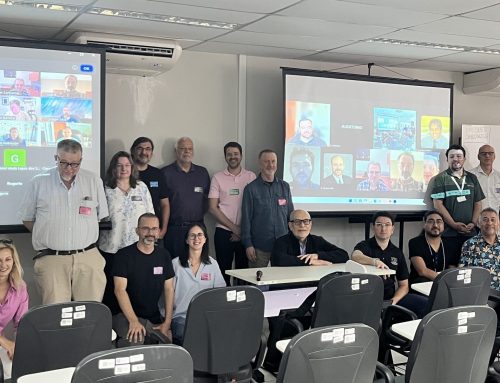
The STEM-Trek TANGO@SC25 workshop, held in collaboration with the Conference on Next-Generation Arithmetic (CoNGA) and Texas A&M University, convened in St. Louis to explore the future of sustainable cyberinfrastructure. Led by industry pioneers like Dr. John Gustafson and Jeffrey Sarnoff, the event highlighted how innovations in next-generation mathematics (such as Posits and Takums), RISC-V, and Compute eXpress Link (CXL) are revolutionizing AI/ML workloads by increasing accuracy while reducing energy and storage demands. Beyond the technical sessions and hands-on Julia training, the workshop fostered global collaboration among 50 participants from eight countries, blending rigorous academic exchange with community-building activities like GIS lab tours and cultural networking, all aimed at preparing the cohort for the broader SC25 supercomputing conference … Read More
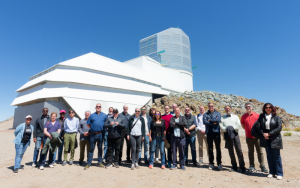
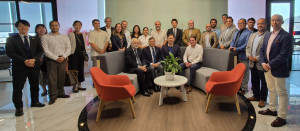
March 4, 2026 In February 2026, Chile became the hub for global scientific collaboration by hosting the Global R&E Network CEO Forum in La Serena. Co-hosted by REUNA and RedCLARA, the high-level event united CEOs from 14 of the world’s leading research and education networks including Internet2, GÉANT, and AARNet to address the future of digital infrastructure. Over four days, leaders tackled critical topics such as the resilience of the Global Research and Education Network (GREN), the impact of AI, identity management, and the role of submarine cables in international connectivity. The forum, essential for aligning infrastructure with the demands of modern science and education, also included a visit to the cutting-edge Vera Rubin Observatory. The group will continue this vital work at their next meeting in Copenhagen, Denmark, in June 2026 … Read More
March 11, 2026 In early 2026, Chile’s national research and education network, REUNA, became the first such network to join the IOWN Global Forum, a consortium of over 170 international organizations pioneering next-generation digital infrastructure. Announced during Congreso Futuro 2026, this strategic partnership connects REUNA with global leaders to develop more sustainable, high-performance optical and wireless technologies, directly supporting the massive data transfer needs of large-scale scientific projects. Katsuhiko Kawazoe, President of the IOWN Global Forum and Executive VP of NTT, emphasized that this alliance strengthens the long history of scientific cooperation between Chile and Japan, providing new opportunities for technological experimentation and early adoption within the academic sector … Read More
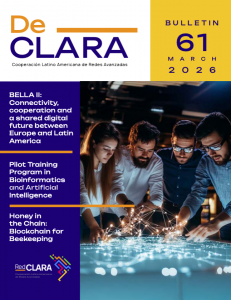
March 31, 2026 The March 2026 edition of the DeCLARA Bulletin highlights a milestone year for RedCLARA as it consolidates significant progress in regional scientific cooperation and digital infrastructure. A central focus is the BELLA II project, which is entering its final implementation phase and has successfully established advanced connectivity and experimental “testbeds” in areas like blockchain, bioinformatics, and high-performance computing. The bulletin showcases real-world applications of these technologies, such as the “Honey in the Chain” initiative using blockchain for sustainable beekeeping traceability and a pilot training program that leverages AI to drastically reduce scientific analysis times for researchers. Additionally, the issue celebrates the launch of Tibr, a new open-access discovery system developed with Arab region partners, further strengthening international bridges for global knowledge exchange … Read More
|