|
||||

|

Press release March 9, 2026
Miami, Florida, March 9, 2026 – The AmLight International Research and Education (R&E) network has activated 1 terabits per second (Tbps) of bandwidth capacity between Boca Raton, Florida and Fortaleza, Brazil, and 1.2 Tbps between Fortaleza and São Paulo, Brazil.
AmLight, a project at Florida International University (FIU), is sponsored by the U.S. National Science Foundation (NSF Award #2537489) and supported through collaboration with partners in the United States, Latin America, and Africa.
The terabit-scale activation was achieved on the Monet submarine cable system, operated by Angola Cables, a key collaborating partner of the AmLight project. To enable this milestone, Angola Cables reconfigured AmLight’s spectrum channels on Monet, allowing AmLight engineers to deploy the Ciena WaveLogic 6E coherent transponder platform, capable of delivering up to 1.6 Tbps per wavelength. AmLight, together with the national R&E network of Brazil, RNP, as well as Angola Cables and Ciena, successfully completed the activation during the week of February 2, 2026, with no disruption to ongoing production research and education activities.
Enabling Data-Intensive Global Science
The terabit capacity significantly expands AmLight’s ability to support data-intensive, geographically distributed science.
Major science programs that will benefit include:
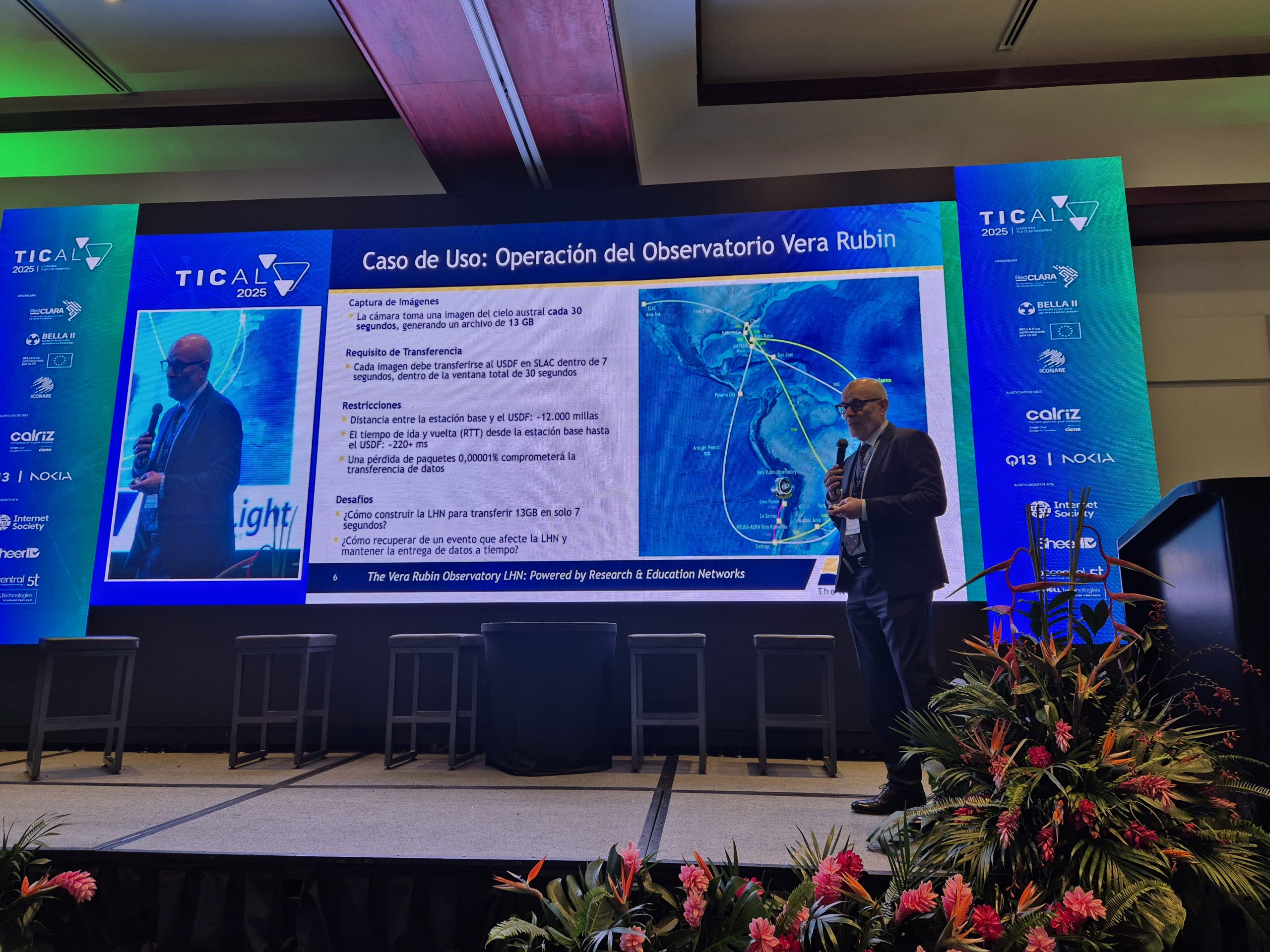
- The Vera C. Rubin Observatory, which requires highly available, dedicated high-capacity bandwidth to transport large volumes of astronomical survey data for rapid processing and analysis.
- Distributed analysis for experiments at CERN’s Large Hadron Collider, where petabyte-scale datasets must be replicated and analyzed across international computing centers.
- Real-time interferometric correlation and imaging for next-generation radio astronomy arrays, where geographically dispersed antennas generate extremely high data rates that must be transported to centralized correlators.
- Global climate and Earth system modeling, enabling rapid intercontinental replication of model outputs and satellite observations to support ensemble simulations and extreme weather forecasting.
- Real-time digital acoustic sensing over terrestrial and submarine fiber infrastructure for geophysical monitoring and early warning research.
- High-resolution imaging science, including cryogenic electron microscopy (Cryo-EM), where individual experimental sessions can generate terabytes of data requiring rapid transfer to high-performance computing facilities.
At 1 Tbps, AmLight can transport approximately 125 gigabytes per second, enabling the transfer of a petabyte-scale dataset in a matter of hours. This capacity allows multiple 100G–400G science flows to operate simultaneously while maintaining the performance and reliability required for mission-critical research workflows.
“AmLight is a key partner of the NSF-DOE Vera C. Rubin Observatory. Their organization and coordination of the South America research and education networks on behalf of Rubin Observatory are critical to our success. AmLight provides dedicated high-speed bandwidth to Rubin, enabling our near real-time science related to transient and variable astrophysical objects” said Robert Blum, Director NSF-DOE Vera C. Rubin Observatory at NSF NOIRLab.
Harvey Newman, Professor of Physics at Caltech and Chair of the Global Network Advancement Group Data Intensive Sciences Working Group said: “The deployment by AmLight and RNP of advanced 1+ terabit per second links between the US and Brazil and within Brazil itself, combined with the most advanced optical infrastructure and intelligent software defined network control systems and services, represents a watershed moment for data intensive sciences and international cooperation, both within the Western hemisphere and worldwide. The use of this new national and intercontinental infrastructure, and the team’s ongoing innovation of services serving many disciplines – from astrophysics to high energy physics, climate science, earth system modeling, and biomedical research – as well as advancing a new paradigm of global acoustic sensing over optical fibers, will accelerate scientific discovery and bring major societal benefits in the years to come.”
About AmLight Next Frontier: AmLight: The Next Frontier Towards Discovery in the Americas and Africa advances and improves a purpose-built international network infrastructure supporting the Vera C. Rubin Observatory, U.S. astronomy projects, major scientific facilities, evolving data-intensive workflows, advanced network testbeds, and Research & Education (R&E) communities across the United States, Latin America, and Africa. Building on its foundational long-haul connectivity, colocation, and software platforms, AmLight is enhancing intelligent network operations, automation, observability, and programmability to ensure seamless integration with large-scale scientific workflows and high-performance data transfers. To meet the growing scale and complexity of global science, AmLight is integrating AI-assisted analytics and intelligent automation into its operational framework. These capabilities enable predictive performance management, anomaly detection, and adaptive orchestration across international domains reducing operational overhead while increasing resilience, efficiency, and performance. Together, these advances position AmLight as a self-optimizing, programmable infrastructure accelerating next-generation discovery and strengthening U.S.-led international scientific collaboration. AmLight is funded by the National Science Foundation (NSF) Office of Advanced Cyberinfrastructure (OAC), awards #2537489, #2029283, and prior grants. Based at Florida International University, AmLight operates through a strategic global partnership including USC-ISI, Vanderbilt University, Rednesp (São Paulo State R&E Network), RedCLARA (Regional Network of Latin America), RNP (Brazil), REUNA (Chile), SANReN (South Africa), the Vera C. Rubin Observatory, AURA, Florida LambdaRail, and Internet2 (http://www.amlight.net/).
About REDNESP (former ANSP): The Research and Education Network at São Paulo (rednesp), former ANSP, provides domestic and international connectivity to dozens of colleges, universities, and R&D institutions of the State of São Paulo, Brazil. Through co-responsibility agreements with consortiums and international academic networks such as AmLight, RedCLARA, and GNA-G, rednesp also manages a 400 Gbps optic fiber ring connecting São Paulo, Miami, and Santiago (Chile), as well as a direct link with Africa. Rednesp is publicly and totally funded by FAPESP, the São Paulo Research Foundation (www.rednesp.br).
About RNP: RNP is the Brazilian National Research and Education Network. We connect people, institutions, ideas, and solutions, democratizing access to knowledge and facilitating digital transformation nationwide. As a social organization, RNP has been committed to the future for over 30 years, acting as a hub for teaching and research, and fostering partnerships that drive scalable solutions and development. RNP mission is to enable connection, dialogue, and co-creation, supporting the Brazilian academic and scientific community to reinvent itself every day (www.rnp.br/en).
About RedCLARA: RedCLARA (Cooperación Latino Americana de Redes Avanzadas) is the regional organisation that interconnects the National Research and Education Networks (NRENs) of Latin America and the Caribbean. Through a secure, high-capacity digital infrastructure, RedCLARA enables advanced connectivity and collaboration among universities, research centers and scientific communities across the region. RedCLARA coordinates regional research networking efforts and facilitates integration with global research and education networks, strengthening Latin America and the Caribbean’s participation in international scientific cooperation. By providing robust infrastructure and collaborative digital services, RedCLARA supports the development of science, higher education, technology and innovation across the region (www.redclara.net).
About REUNA: Red Universitaria Nacional, is Chile’s National Research and Education Network, a non-profit corporation that connects universities, research centers, and scientific projects, such as major astronomical observatories, through an advanced 12,500-kilometer digital infrastructure that spans the country from Arica to Punta Arenas. REUNA brings together more than 50 academic and scientific institutions and offers high-speed transmission capabilities, with backbone links of 100 Gbps or higher, enabling the exchange of massive data volumes—on the order of hundreds of petabytes annually—essential for disciplines such as astronomy and AI applications. Through its international connectivity, REUNA links Chile to academic networks in more than 100 countries, positioning the country as a strategic hub for global scientific collaboration and facilitating the development of science, education, and digital innovation (www.reuna.cl).
About TENET/ SANReN: The South African National Research Network (SANReN) (https://www.sanren.ac.za/) group is responsible for the design, acquisition and roll-out of national and international capacity for the South African NREN (SA NREN), as well as the development and incubation of advanced services. It forms part of a comprehensive South African government approach to cyberinfrastructure, geared at ensuring the successful participation of South African researchers in the global knowledge production endeavour. SANReN is managed and implemented by the Council for Scientific and Industrial Research’s (CSIR’s) Next Generation Enterprises and Institutions (NGEI) cluster and is a key component of the National Integrated Cyberinfrastructure System (NICIS) (https://nicis.ac.za/), alongside the Centre for High Performance Computing (CHPC) and the Data Intensive Research Initiative of South Africa (DIRISA). TENET’s (https://www.tenet.ac.za/) main purpose is to secure, for the benefit of South African universities and associated research and support institutions, Internet and Information Technology services. TENET is a service organization and is committed to service excellence and to services that are strongly aligned and consistent with the organizational requirements of the user community. TENET operates the SANReN network under the terms of a collaboration agreement with the CSIR. The roles and responsibilities of the de facto SA NREN are distributed between SANReN and TENET.
|
|