

Americas-Africa Lightpaths Express and Protect (AmLight-ExP) project
 Florida International University’s Center for Internet Augmented Research and Assessment (CIARA), in the Division of IT, is pleased to announce a new $3.8M five-year award from the U.S. National Science Foundation (NSF), Award# OAC-2029283, for the International Research and Education Network Connections Core program: Americas-Africa Lightpaths Express and Protect (AmLight-ExP) project.
Big data science in South America and Sub-Saharan Africa will be dramatically evolving over the next five years, with increasing dependency on advanced cyberinfrastructure and programmable networking. Significant projects include the Vera Rubin Observatory in Chile, Brazilian participation in the High Luminosity Large Hadron Collider experiments at CERN, and the Square Kilometer Array in South Africa … Read More
AmLight News
FIU awarded for AMLIGHT to provide an Advanced International Network for the Rubin Observatory Legacy Survey of Space and Time through 2031. Read More…
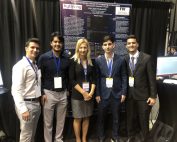
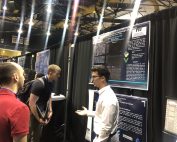
AmLight Kytos-ng
AmLight Kytos-ng students (Ruben Cerna, Christopher Alvarez, Pedro Garcia, [...]
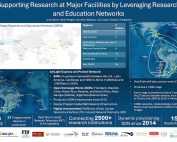
AmLight Cyberinfrastructure highlighted at NSF 2024 Research Infrastructure Workshop
AmLight Cyberinfrastructure was highlighted at the NSF 2024 Research [...]
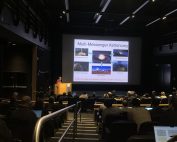
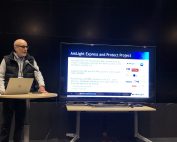
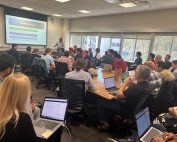
The Fifth National Research Platform (5NRP) workshop
Scientific exploration and discovery were facilitated by increasingly specialized [...]
AmLight ExP 2015 – 2020
 In response to the growing network requirements of these U.S.-Latin America collaborative science research activities, the Americas Lightpaths Express and Protect (AmLight ExP) project implements a hybrid network strategy that combines the use of optical spectrum (Express) and leased capacity (Protect), in order to build a reliable, leading-edge network infrastructure for research and education. The total production bandwidth provided by AmLight ExP between the U.S. and South America will grow to more than 680G over the next five years … Read More
AmLight Project 2010 – 2016
Americas Lightpaths, AmLight, enables research and education amongst the people of the Americas. The enablement is through the operation of production infrastructure for communication and collaboration between the U.S. and Western Hemisphere science and engineering research and education communities … Read more

AmLight ExP Partners






AmLight ExP project is supported by NSF Award #1451018 and #2029283. Any opinions, findings, and conclusions or recommendations expressed in AmLight ExP materials are those of the author(s) and do not necessarily reflect the views of the National Science Foundation.